What Is Ghost Mannequin Photography? Which Products It Works For, and Which It Doesn't
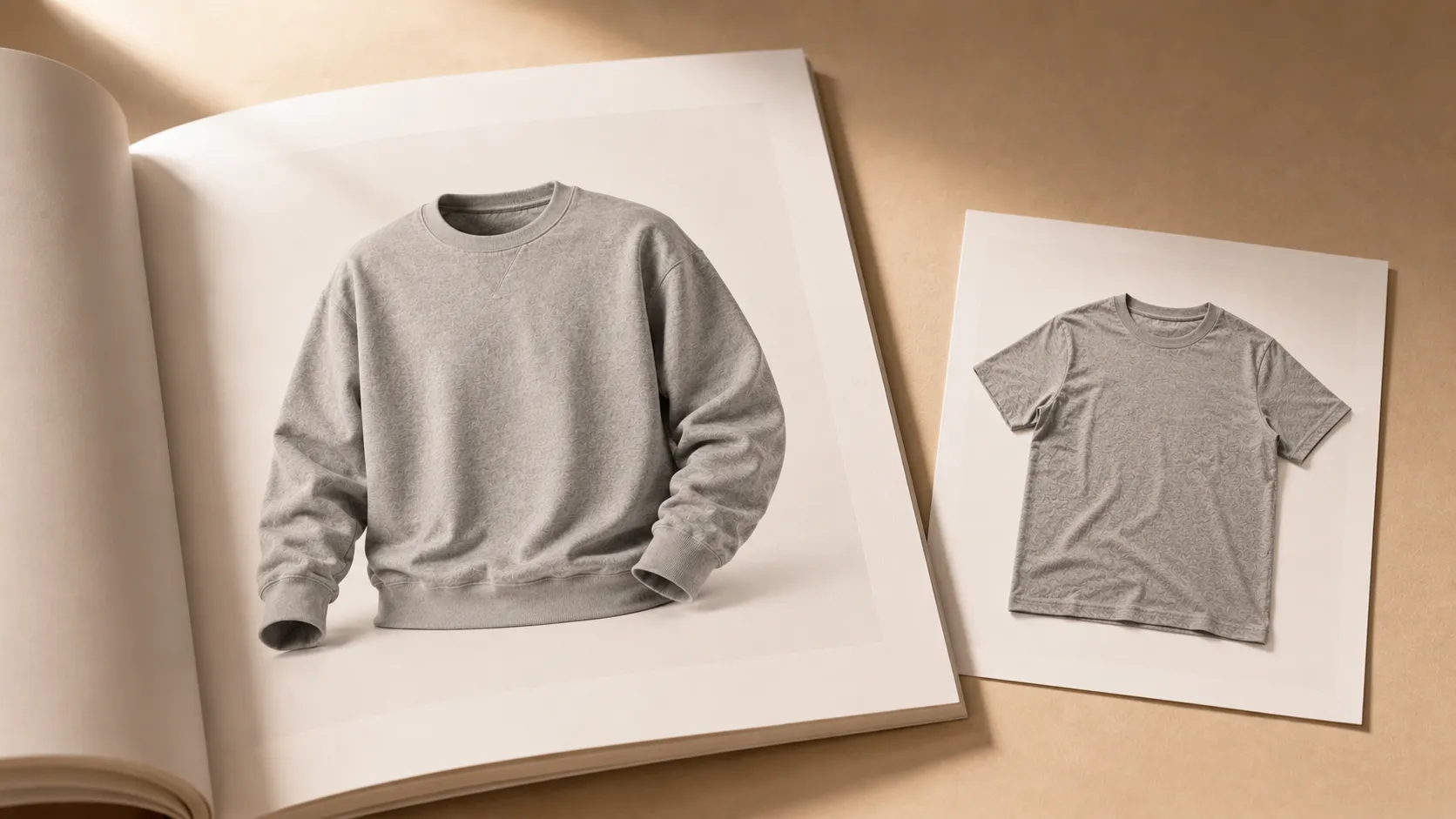
Ghost mannequin is a product photography technique in which a garment looks worn by an invisible mannequin. The product is shot on a special mannequin, the inside neck and other details are shot separately and merged in, and the mannequin is removed. The product keeps its volume and shape, with nothing to distract. It is also called invisible mannequin photography.
Browse a marketplace and you’ll see two kinds of clothing photos: one spread flat on a table; the other full of volume, as if someone were wearing it. The second is ghost mannequin.
The difference isn’t aesthetic, it’s informational. A T-shirt laid flat doesn’t show its cut; in a ghost shot the shoulder width, sleeve length and cut of the body are visible.
How is a ghost mannequin shot taken?
There are more steps to the process than it seems.
Mannequin preparation. The product is dressed onto a special mannequin that comes apart in sections. Sizing is critical: a product that is too big sags, and one that is too small stretches. Both show the cut wrongly.
Main shot. With the product on the mannequin, it is shot from the front and, if needed, from the back. The light is set to show the texture of the fabric, and the shadow to define the form.
Detail shots. The inside neck, the label area and the cuffs are shot separately. In the merging stage they become the “inside” of the product.
Compositing. The mannequin is removed digitally, the detail shots are placed where they belong, and the product is cut out cleanly with its form intact.
The last step is the hard one. In a badly done ghost shot the inside neck looks patched, the shoulder line looks broken and the drape of the fabric is lost.
Which products does it work for?
Textile products that take a body shape: T-shirts, shirts, sweatshirts, sweaters, jackets, coats, dresses, trousers, underwear.
What they share is that the cut decides the purchase. The customer is looking for an answer to “how will this fit me?”
Which products does it not work for?
Most guides leave this part out, yet it matters most for the decision.
Unstructured, soft products. Silk scarves, shawls, fine knits: they don’t take shape even on a mannequin and look shapeless in a ghost shot. A flat lay gives better results.
Accessories and jewelry. They don’t take a body shape, so none of the technique’s advantages apply.
Shoes and bags. They have their own form; ghost logic can’t be applied.
Products that sell on how they hang. How an evening dress drapes, how a coat sits on the shoulder: these are explained far better on a live model. A ghost shot is technically possible, but it hides the product’s strongest quality.
Layered outfits. Pieces worn on top of each other merge into one another in a ghost shot.
Ghost fits
- T-shirts, shirts, sweatshirts
- Jackets, coats, dresses
- Trousers, underwear
When the cut decides the purchase.
Ghost doesn't fit
- Scarves, shawls, fine knits
- Jewelry, accessories, bags
- Shoes, layered outfits
Products that hold no shape or sell on how they hang.
The question isn't which technique is better; it's which one this product needs.
How does it compare with the alternatives?
| Method | What it shows | Weak side |
|---|---|---|
| Ghost mannequin | Cut, shape, volume | No feeling or use scenario |
| Flat lay | Pattern, color, measurements | Cut and drape aren’t visible |
| Live model | Drape, style, use scenario | Costly, hard to scale, attention can drift from the product |
| AI model | Variety of scenes and variants | Fabric texture and cut accuracy are at risk |
What most brands actually need is not to choose but to mix: ghost in the catalog, a live model in the campaign, lifestyle on social media.
How does it relate to marketplace image rules?
Ghost mannequin fits marketplace main-image rules naturally. Amazon asks for a pure white background and for the product to fill most of the frame; a ghost shot is already produced on white, with the product in the center. Our Amazon image requirements guide covers the full list, and Trendyol’s rules are in our Trendyol guide.
There is also an indirect advantage: in images that contain a mannequin or model, platform rules can get more complicated. A ghost shot contains no human figure, so that layer never comes into play, including newer obligations such as the contains-synthetic-performer tag Amazon requires for images with AI-generated people.
Can ghost mannequin be done with AI?
Partly, and with care.
AI tools can speed up removing the mannequin and making the cutout. Since that is the most time-consuming part of the technique, it is a real gain.
But there are two risks. First, in the inside-neck composite, AI can invent details that aren’t there: a seam or a label that your product doesn’t have shows up in the image. Second, when the fabric texture is regenerated it can come out different from the real thing; the customer sees the difference when they open the box.
Our approach: the product is actually photographed, and AI is a tool that speeds up the process. Just as we don’t generate the dish itself, we don’t generate the garment itself.
If you want to leave the model, rather than the product, to AI, that is a different job: there the problem is that the model turns out to be a different person in every frame. Modelhane is built for exactly that: each of the 130 models on the roster has a fixed identity, and it gives you the production code for free.
Frequently Asked Questions
Is ghost mannequin photography more expensive than flat lay?
In our experience, usually yes, because it needs extra shots and a compositing step. Compared with a shoot on a live model, though, it is often more economical and better suited to high volume. The price depends on the number of products and the number of angles delivered.
How many angles do you need to shoot?
A basic ghost set usually consists of the front view and the inside-neck detail, which becomes the inside of the garment in the final image. A back view, a side angle and a fabric detail are added depending on the product and the sales channel.
Can I have it shot on my own mannequin?
No. Ghost shooting needs a special mannequin that comes apart in sections; a standard shop-window mannequin doesn’t allow the inside-neck composite. You don’t need to provide one: once you send us the product, the shoot is done at our studio with our own equipment.
Should every product be shot as a ghost?
No. It gives strong results for textile products where the cut decides the purchase. For accessories, jewelry, shoes, bags and unstructured fabrics, other methods such as flat lay or a live model fit better. We go through your product list with you and decide together which product gets which technique.
Let’s prepare your collection with ghost shooting.
Catalog images that show the cut correctly, follow marketplace rules and stay consistent. Take a look at our product photography service.
Marketplace image rules: Trendyol · Amazon
Our approach to production: Production Principles
Sources (3)
- Amazon Seller Central — Product image guide — sellercentral.amazon.com
- Trendyol Akademi — Ürün Görseli Seçimi ve Yükleme (in Turkish) — akademi.trendyol.com
- Pixelz — Ghost Mannequin Photography: How to get 3D product images — pixelz.com