Why Is Filming in a Gym So Hard?
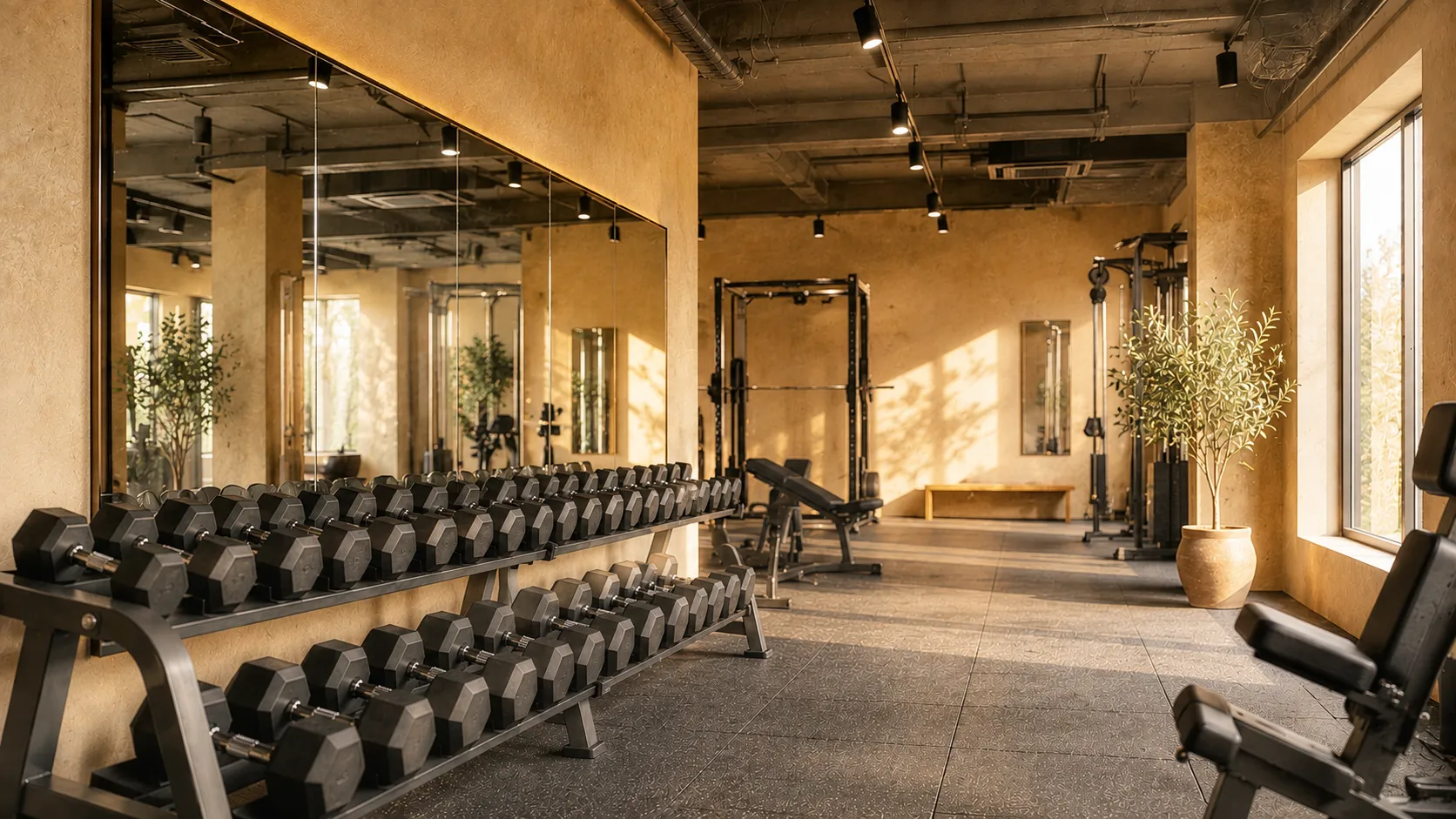
Created with the support of AI technologies.
A gym is a hard place to film. Mirrors pull the camera operator and the members in the background into the frame, overhead fluorescent light shadows the face and flattens muscle definition, and weights and music drown out your voice. These are four separate problems, and all four are solved before the shoot, while you set up the frame.
What do the mirrors give away?
Most gyms have wall-to-wall mirrors so members can check their own form. From a camera’s point of view, that puts half of your frame out of your control.
When you stand square to a mirror, it reflects back whatever is there: the camera operator, the tripod, the light, the member checking their phone in the back. The fix isn’t to avoid the mirror in front of you but to stand at an angle to it. Place the camera at roughly 30-45 degrees to the mirror and the reflection slides out of the frame; the athlete still works in front of the mirror, and you stay out of sight.
The second route is to use the reflection on purpose. A movement seen from the front and in the mirror at once is two angles in a single frame; for form-focused content that is a gain, not a loss. But then you need to be sure that everything in the mirror is something you want in the frame.
A practical check: before you start rolling, freeze the frame and look at the mirror. If there is something in it you don’t want to see, move the camera a step to the side. This is one of the few mistakes that editing can’t fix afterward.
Why isn’t the overhead light enough?
Gym lighting is recessed into the ceiling and has one job: lighting the floor evenly. That’s good for walking and bad for filming.
Light coming straight down leaves the eye sockets and the area under the chin in shadow and makes the face look tired. Because the same light hits the muscle surface head-on, it also flattens volume; definition in the shoulders, back and arms disappears. What makes muscle definition visible isn’t the amount of light but the fact that it comes from the side. It’s the edge of the shadow that draws the volume.
Three practical fixes do most of the work:
- If there’s a window, face it. Place the athlete at roughly 45 degrees to the window; you get free, soft light from the side.
- Bring a portable LED panel. Even a small panel beats the ceiling light when it is placed in front of the athlete and off to one side, slightly above eye level.
- Don’t shoot directly under a fixture. Moving the athlete a step or two is often enough to soften the shadow, and it takes no equipment at all.
Which movement from which angle?
The angle isn’t an aesthetic choice; it determines what the movement says. In content that explains form, the wrong angle makes the content wrong.
| Movement | Angle and framing |
|---|---|
| Squat, deadlift | From the side — the knee, hip and back line must all be visible in the same frame |
| Plank, bridge | From a low angle, almost at floor level — the line of the torso reads clearly |
| Back movements (row, lat) | From behind — the shoulder blades’ work is only visible from here |
| Upper body (press, curl) | From a diagonal angle — torso and arm angle at the same time |
| Treadmill, cardio | From the side and slightly behind — the rhythm of the stride shows |
There is one rule for framing: the whole movement must stay in the frame. A close-up looks tempting, but at the bottom of a squat the knee leaves the frame, and at the top of a deadlift the shoulder does, which is exactly the moment you wanted to explain. Vertical video already leaves little room: Instagram Reels accepts formats up to 9:16, so give that frame to the athlete’s whole body and nothing else.
When does slow motion work?
Slow motion doesn’t work everywhere; it works at the peak moment: the very top of a jump, the second the weight goes from lift-off to lockout, the first instant of an explosive movement. Showing a whole set in slow motion tires the viewer and kills the rhythm of the movement.
It also has a technical cost. Slow motion means more frames per second, and the more frames there are, the less light falls on each one. Shooting at a high frame rate in a dim gym produces noisy, grainy footage. If the gym is dark, either add light or lower the frame rate; you can’t have both.
The routine that works on location: show the same movement first at normal speed, then again in slow motion. The viewer sees the movement once as a whole and studies the critical moment on the second pass. It pays off in the edit too: one shot yields two different rhythms.
Don’t forget the publishing threshold either. According to the Instagram Help Center, Reels asks for a minimum of 30 frames per second; after you slow the footage down, the output must not drop below that threshold.
What about sound and the background?
At least three sounds are going in a gym at once: weights hitting the floor, the gym’s music, and the air conditioning. A phone’s built-in microphone records all three at roughly the same volume as your voice, because it listens to the room, not to the person speaking.
The fix is simple and cheap: a lavalier mic. A small microphone clipped to the athlete’s collar picks up sound at the source, so gym noise drops into the background. In content with narration, this single investment makes more difference than upgrading the camera.
If there’s no narration, you can build the sound design in the edit; the sound of the weight can be deliberately left in and the music placed under it. But that decision is made in the edit, not on the shoot, which is why the raw audio has to be recorded clean from the start.
The background has a visual side too: other members are in the frame. Filming and publishing a recognizable person without their consent is processing personal data, and Law No. 6698 on the Protection of Personal Data (KVKK) makes it, as a rule, subject to explicit consent (Article 5/1); the cases in which explicit consent is not required are listed separately in the Law (Article 5/2). A general clause in the gym’s membership contract doesn’t count as that consent; consent that isn’t tied to a specific subject is treated as “blanket consent” and considered invalid. In practice there are three routes: film during the gym’s empty hours, tighten the frame so it cuts out the background, or get separate permission for that shoot from the person who will appear.
What can you promise, and what can’t you?
Once the technical side is solved, the question becomes what the content says. What a personal trainer explains is exercise, not a health outcome.
Here is where the line falls: explaining how a movement is done is the trainer’s territory. Guaranteeing a result, saying that an ailment will go away, or giving a personalized nutrition program is not. As a general assessment: statements that promise health outcomes fall under advertising regulation; claims of treatment and recovery belong to the physician, and personalized nutrition programs belong to the dietitian.
What you can talk about
- Exercise technique and form explanations
- Training plans and program structure
- Motivation and routine content
- Your own transformation story
What you can't talk about
- Weight-loss guarantees
- Treatment or recovery claims
- Personalized nutrition programs
- Before-and-after images of clients
This may look like a content restriction, but in practice it works the other way. Technique explanations, plans and your own story are already the most-watched formats. A promise gets clicked in the short run; technique gets people to follow you in the long run.
Frequently Asked Questions
A mirror in the gym shows the camera operator. What should I do?
Work at an angle instead of standing square to the mirror. Place the camera at roughly 30-45 degrees to the mirror and the reflection slips out of the frame while the athlete stays in front of the mirror. Freezing the frame and checking what the mirror shows before you start rolling rules out shots you can’t rescue later.
Do I need a special camera for slow motion?
Most current phones can shoot at a high frame rate; the real limit is light, not the camera. Slow motion means more frames per second, so each frame gets less light. In a dim gym, a high frame rate produces grainy footage; adding light does more than changing cameras.
Should I film when the gym is empty?
If you can, yes. An empty gym solves three problems at once: no recognizable members in the background, less noise from weights and conversation, and the freedom to place equipment as you like and repeat the same shot. Early morning and the lunch break are the quietest windows at most gyms.
Do I need permission from members who appear in the background?
Filming and publishing a recognizable person is processing personal data and, as a rule, requires explicit consent. A general clause in the gym’s membership contract does not cover it; consent that isn’t tied to a specific subject is considered invalid. Practical fixes: film at an empty hour, tighten the frame, or get separate permission from that person.
Turning the gym into a set
A gym is a hard place to film, but not an unsolvable one. Mirrors, light, sound and framing: all four are decisions made before the shoot day. Once set up correctly, the same arrangement is repeated every month, and producing content stops being a job you wrestle with one clip at a time.
IDIFO films on location for personal trainers and gyms; we bring the lights, the microphone and the plan with us. You can look at vertical video shoots for Reels and Shorts, including the section for those who say “I already shoot with my phone,” and see our on-location shoot services for the full scope.
Sources (3)
- Instagram Help Center — Reels video size and aspect ratios on Instagram (aspect ratio 1.91:1–9:16, minimum 30 FPS and 720 pixels) — help.instagram.com
- Personal Data Protection Authority (KVKK) — Points to Consider When Obtaining Explicit Consent (in Turkish; invalidity of "blanket consent") — kvkk.gov.tr
- Legislation Information System — Personal Data Protection Law (No. 6698) (in Turkish; definition of explicit consent: Article 3; conditions for processing: Article 5) — mevzuat.gov.tr