Real Estate Social Media After EİDS: What You Can and Can't Share
Last updated:

Created with the support of AI technologies.
Last reviewed:
What changed
When all three conditions are met, sharing images, video and price is allowed; hiding the price is a violation in itself. Under the previous regime, only the link to a verified listing could be shared. The basis comes from two documents: the Ministry letter announced to the chambers allowed images and price, while the price requirement comes from the Ministry's public announcement of August 22, 2026. Checks on September 15 and October 20, 2026 found no change in the rule; the Ministry's announcement of October 19, 2026 repeated the three conditions and also named TikTok among the platforms. Enforcement data now includes the Ministry's nine-month balance sheet of October 6, 2026 and the totals in the October 19, 2026 announcement.
A Ministry letter to the chambers in August 2026 and the Ministry's August 22, 2026 announcement changed EİDS's social media regime. Licensed real estate businesses can share listings, including photos, video and price, on three conditions: a verified EİDS listing link, images from that listing, and a clearly stated price. Hiding the price (“DM for price”) is itself a violation.
Social media has become a real estate agent’s strongest storefront. The rules for that storefront tightened first: according to the Ministry’s announcement of June 13, 2026 and its letter of June 17, 2026, only the link to a verified listing could be shared on social media. The Ministry of Trade letter announced to the chambers in August 2026 shifted the balance: businesses holding an authorization certificate (yetki belgesi) that meet three conditions can now share photos, video and price as well. But this is conditional permission, not a free-for-all: for anyone who doesn’t know the conditions, the risk of a fine hasn’t gone anywhere.
What is EİDS, and why does it cover social media?
EİDS (Elektronik İlan Doğrulama Sistemi, the Electronic Listing Verification System) is a Ministry of Trade regulation that makes identity and authorization verification mandatory for real estate and vehicle listings. Its purpose is to prevent fake listings, listing clutter and speculative price increases. According to the Ministry’s letters to TESK and TOBB, authorization verification became mandatory for rental property listings on January 1, 2025; the start date was set at April 7, 2025 for commercial premises for sale, and at February 15, 2026, in all provinces, for all other properties for sale, including housing. The scope includes social media: the Ministry’s announcement of October 19, 2026 (in Turkish) says that identity and authorization verification is mandatory for listings published electronically, including on Instagram, Facebook, WhatsApp and TikTok; the Ministry monitors property listings on these platforms.
August 2026 change: images and price are allowed on three conditions
The letter from the Ministry of Trade’s Directorate General of Domestic Trade was sent to the chambers through TOBB and reached members through announcements the chambers published on August 13–14, 2026. The Ministry’s earlier letter of June 17, 2026 said that only the link to a verified listing could be shared on social media; the new assessment conditionally relaxed that line, on the grounds that businesses holding an authorization certificate should be able to make effective use of increasingly digital marketing channels.
Today’s framework comes from two separate documents, and they say different things. The letter announced to the chambers lists two conditions — a verified listing link, and images that belong to that listing — and says that including the price has been “found appropriate”; in other words, it permits the price. What makes the price mandatory is the Ministry’s public announcement of August 22, 2026, which says that businesses “must include the listing price in addition to the listing link.” The three conditions are what the two documents add up to.
For a post to count as compliant, all three conditions must be met together:
- A verified listing link — the post must carry the link to the listing verified through EİDS.
- Images must belong to that listing — photos, video and descriptions must relate to the property in the verified listing; another property’s image cannot be used.
- The price must be clearly stated — the price must appear in the post; hiding it behind a “DM for price” line breaches the rules. (The source is not the letter announced to the chambers but the Ministry’s public announcement of August 22, 2026.)
The scope did not change: the rules apply to all listings published electronically, and the Ministry’s announcement of October 19, 2026 names TikTok explicitly alongside Instagram, Facebook and WhatsApp. What changed is not the boundary as such but where it is drawn: the old line was “listing details cannot be shared”; the new one is “nothing unverified, and nothing that fails the conditions, can be shared.” WhatsApp’s own storefront mechanics — the catalog grid, the cover frame, shooting with a phone — are a separate subject, covered in our WhatsApp catalog image guide.
Where is the line between a compliant and a fined post?
The old axis was “listing-type content / free”; the new axis is “compliant / fined”. A compliant listing post brings four elements together:
- A verified EİDS listing link — the post’s anchor of legitimacy
- Photos and video from that listing — not another property’s frame
- A clearly stated price — no hiding, shortening or “DM” redirect
- A description consistent with the listing — the text does not contradict the information in the verified listing
On the fined side: sharing an unverified listing, using an image that belongs to another property, hiding the price (“DM for price”), posting listing-type content without a verified listing link, and brokering without an authorization certificate.
Fined post
- Unverified listing
- Image from another property
- Hidden price (“DM for price”)
- Listing post without a link
- Brokering without an authorization certificate
Fine of up to TRY 286,206 per violation
Compliant post
- Verified EİDS listing link
- Photos and video from that listing
- Clearly stated price
- Description consistent with the listing
- Brand / neighborhood content — free of conditions
Free when all three conditions are met
Right and wrong: two posts of the same listing
Same apartment, same photo, two separate posts. The first meets all three conditions; the second uses the photo correctly but hides the price and cuts off the path to the listing. We cover where each condition goes in a post separately in the anatomy of a compliant post.
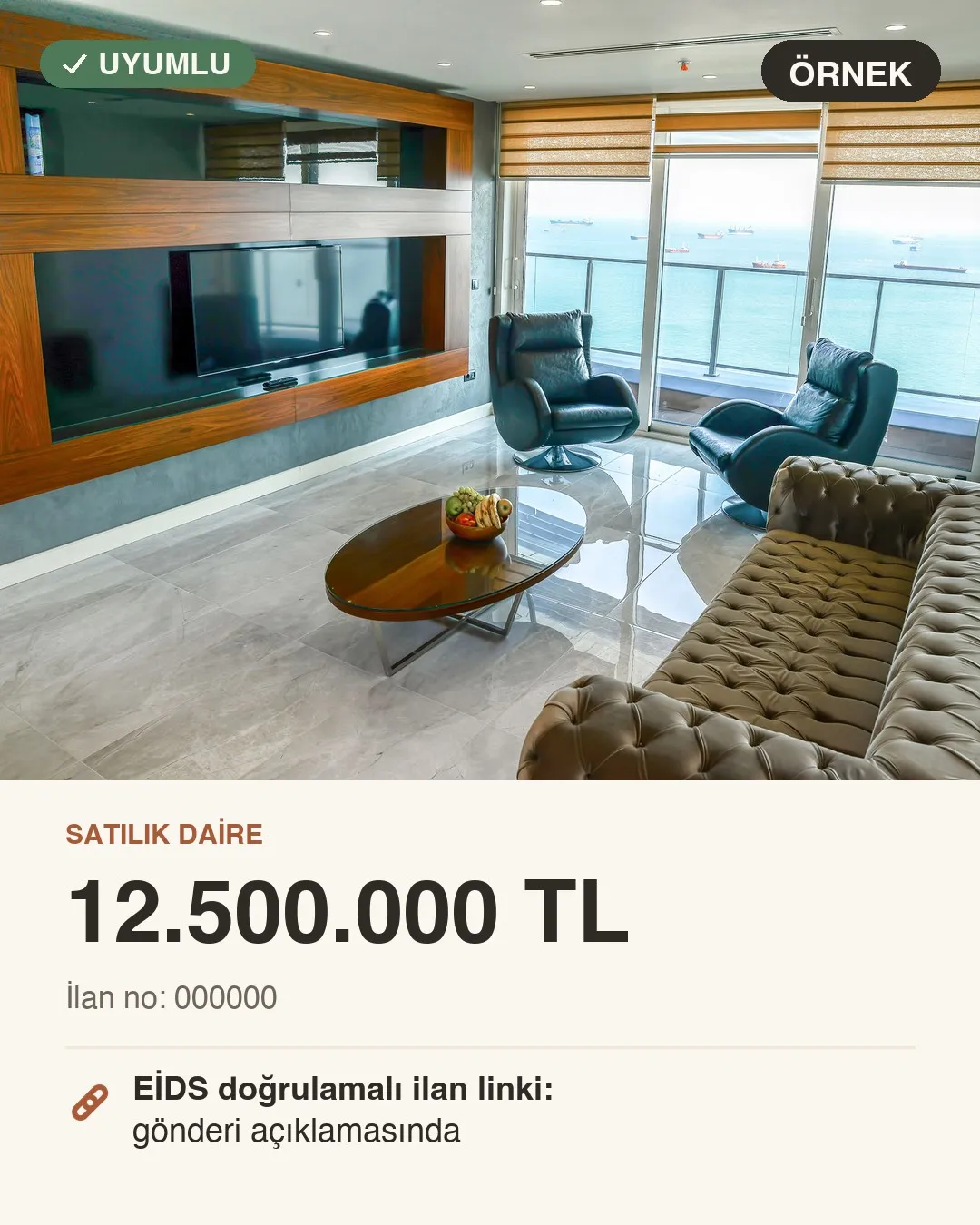
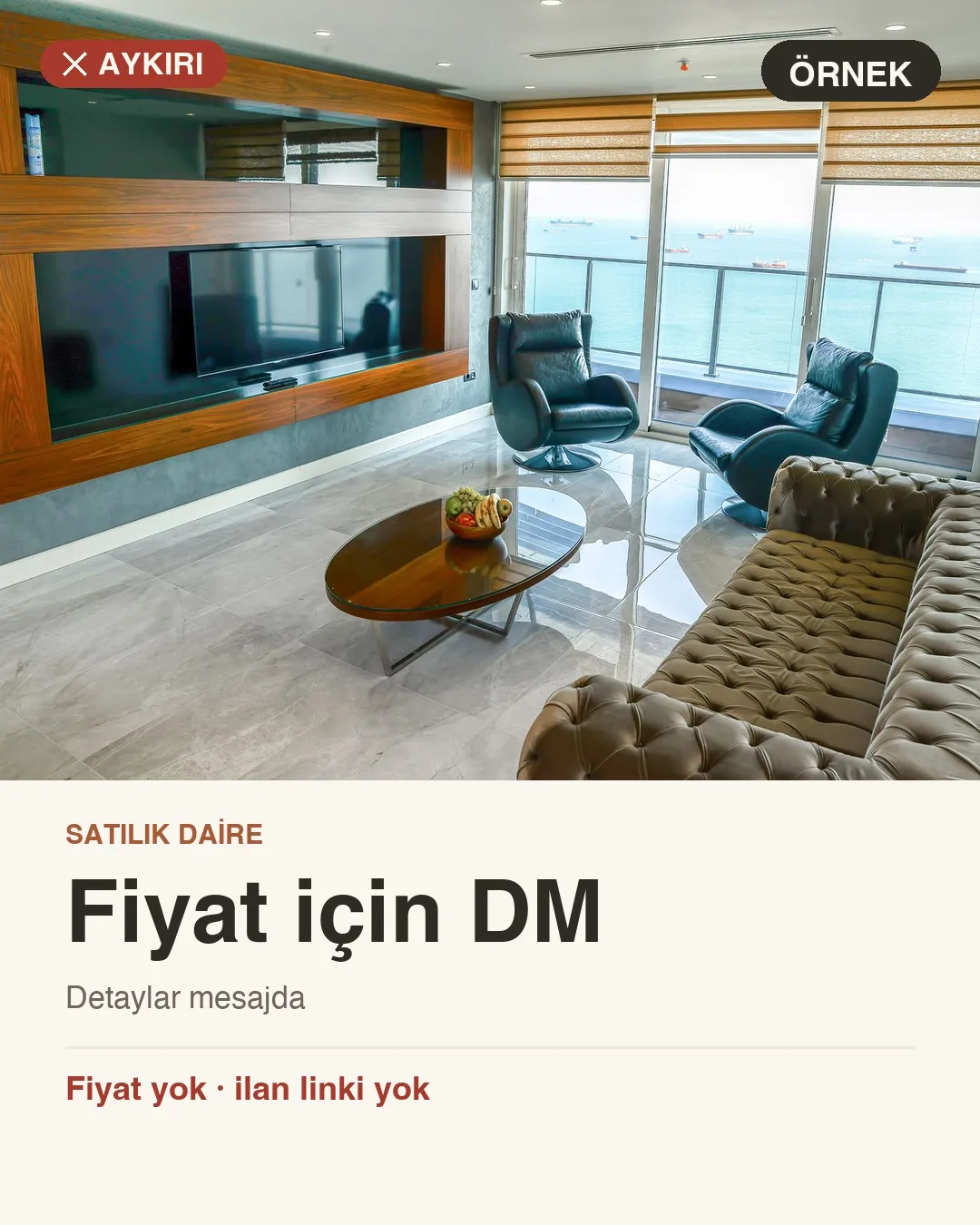
- Link: The first post says where the verified listing link is, and the link sits in the caption. The second offers no path to the listing; the first condition is not met.
- Image: Both posts use the same photo, and it shows the apartment in the listing itself; the second condition is met in both. But this condition alone does not make a post compliant.
- Price: In the first post the price is written as a figure where it can be seen. “DM for price” in the second fails the third condition outright and counts as a violation in itself.
How do the same rules apply to a story?
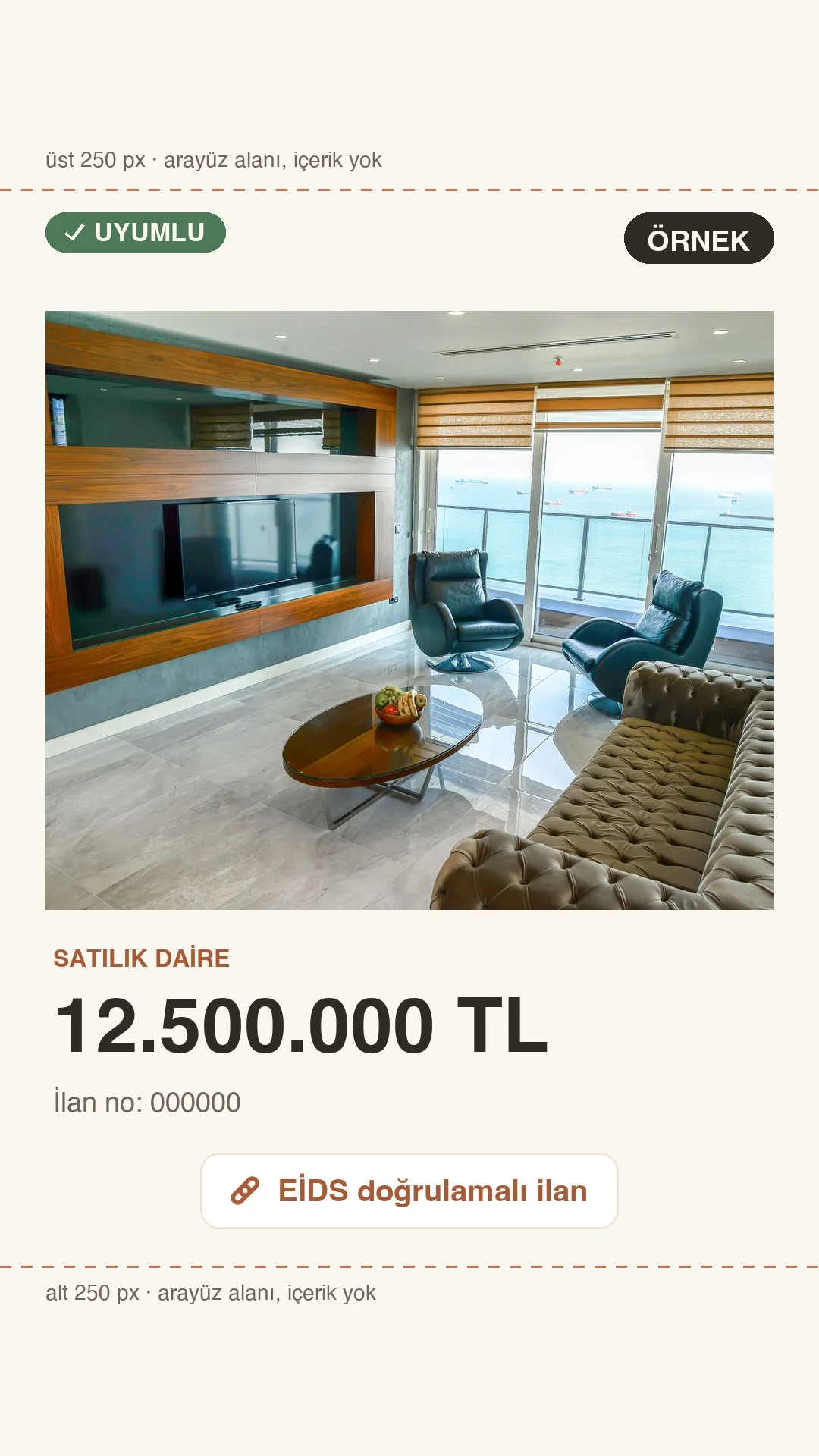
A story disappears after 24 hours, but it is still a listing post; the link, listing-image and clear-price conditions apply in full. Because the profile name and the reply bar cover the top and bottom edges of the screen, keep the price and the link label outside those two bands — 250 pixels each in the template.
Enforcement: oversight has not loosened, and fines are still being issued
For posts that breach the conditions, an administrative fine of up to TRY 286,206 applies for each violation found. Ministry data shows how real the oversight is: according to the market inspection balance sheet the Ministry of Trade announced on September 11, 2026, administrative fines of TRY 39,028,000 were imposed on the real estate sector in the Directorate General of Domestic Trade’s inspections in the first eight months of 2026. According to the balance sheet the Ministry announced on October 6, 2026 (in Turkish), the same item stood at TRY 45.6 million at the end of the first nine months of 2026.
Oversight did not loosen just because the rules did. According to the Ministry’s statement of August 22, 2026, administrative fines totaling TRY 8.2 million — TRY 100,000 each — were imposed on 42 real estate and 40 car dealership businesses that shared listings in breach of the rules. The same statement said that META would block access to the social media accounts concerned — so the risk is no longer just a fine but losing access to the account.
According to the Ministry’s announcement of October 19, 2026, administrative fines totaling TRY 7 million were imposed on 70 real estate and car dealership businesses that shared listings in breach of the rules on Instagram, Facebook and TikTok; with this, the number of businesses sanctioned reached 152 and the total administrative fines TRY 15.2 million. These totals cover real estate and vehicle listings together; the announcement does not give the share of real estate businesses separately. The same announcement reported administrative fines on the platforms too: TRY 20 million on Meta Platforms İstanbul Bilişim Hizmetleri Limited Şirketi and TRY 4 million on TikTok İstanbul Dijital Medya ve Reklam Limited Şirketi, which were found to have neither integrated with EİDS nor fulfilled their identity and authorization verification obligations. The total administrative fines imposed on Meta in this context reached TRY 36.2 million.
What’s next: is a single authorization per property coming?
The press reported that the Ministry of Trade is working on authorizing only one real estate business per property, uploading the authorization contract to the system, and removing the listing automatically when the authorization is canceled; as of October 20, 2026, however, there is no draft, no text opened for public consultation and no text published in the Official Gazette (Resmî Gazete). We are tracking the status of the plan in the EİDS regulation record.
IN FORCE TODAY
PLANNED · NO OFFICIAL TEXT
While waiting to see whether single authorization arrives, what you can do today is put your existing documents in order before the year ends: for your authorization certificate, the validity period of your MYK certificate and EİDS compliance, see the real estate agent year-end checklist.
How does an EİDS-compliant social media presence grow?
At first glance the freedom seems to have leveled the competition: everyone can post listings again. But conditional freedom actually raised the bar. With the price now required to be stated openly, the “pull them into DMs and haggle” tactic is finished; once everyone shares the same property with its price, the difference shifts to the quality of the images and the storytelling. The account that gets the most clicks on the link to the verified listing will be the account that shows the property best. Brand, neighborhood and expertise content also remain free of conditions — an account that builds trust gets more business from its listing posts too.
Frequently Asked Questions
Can a real estate agent post anything on social media at all?
Yes. Under the Ministry letter announced to the chambers in August 2026 and the Ministry’s August 22, 2026 announcement, licensed real estate businesses can share listings on three conditions: a verified EİDS listing link, images from that listing, and a clearly stated price. Brand promotion, neighborhood content and sector information were always free, with no conditions attached.
What is the penalty for breaching EİDS in a post?
Each violation found carries an administrative fine of up to TRY 286,206. The Ministry’s August 22, 2026 statement reported fines totaling TRY 8.2 million on 82 real estate and car dealership businesses. According to its October 19, 2026 announcement, sanctioned businesses had reached 152 and total fines TRY 15.2 million; these totals cover real estate and vehicle listings together.
Can I share a photo of an apartment on Instagram?
Yes, if three conditions are met. The post must carry the EİDS-verified listing link for that apartment, the photo and description must belong to the property in the verified listing, and the price must be clearly stated. Hiding the price behind “DM for price” or using another property’s image counts as a violation and risks a fine.
Do WhatsApp posts count too?
Yes. The rule covers all listings published electronically, including listings on Instagram, Facebook, WhatsApp and TikTok. The new conditions apply the same way on all of these platforms: when you share a listing in a WhatsApp status or group, the verified listing link, images from that listing and a clearly stated price are still required.
Let’s set up your social media in line with EİDS.
Before sharing property photos you shot on your phone, try the free Real Estate Photo Assistant: it corrects dark exposure and color balance in your browser and strips location (GPS) data, so your photos are ready to share. Compliance itself depends on three conditions: a verified listing link, an image from the listing, a clear price.
Social media content that grows your brand without risking a fine, from listing posts that meet the three conditions to neighborhood features, and from your office’s story to expertise videos: we’ll plan and produce all of it in line with EİDS. See our real estate visual and content service.
The price requirement itself and the anatomy of a compliant post: Real Estate Listings on Social Media: Stating the Price Is Now Mandatory
Where competition moved once listings were tied to authorization: Real Estate Competition After EİDS
What is happening abroad on the image side: California AB 723
We track the other current regulations that concern your sector in one place too: More current regulation topics →
Sources (17)
- T.C. Ticaret Bakanlığı — EİDS kapsamında sosyal medya denetimi; 82 işletmeye 8,2 milyon TL idari para cezası ve ilan fiyatı bilgisinin zorunluluğu (August 22, 2026 public announcement; in Turkish) — ticaret.gov.tr
- T.C. Ticaret Bakanlığı — Sosyal medyada taşınmaz ve taşıt ilanlarına yönelik denetimler; 152 işletmeye toplam 15,2 milyon TL idari para cezası, Meta ve TikTok'a idari para cezası (October 19, 2026 public announcement; in Turkish) — ticaret.gov.tr
- T.C. Ticaret Bakanlığı — Sosyal medyada EİDS'ye aykırı ilanlar; Meta'ya 5 milyon TL idari para cezası, işletmelerin yalnızca doğrulanmış ilan linkini paylaşması (June 13, 2026 public announcement; in Turkish) — ticaret.gov.tr
- Taşınmaz Ticareti Hakkında Yönetmelik (Regulation on Real Estate Trade; in Turkish) — Mevzuat Bilgi Sistemi
- 6585 sayılı Perakende Ticaretin Düzenlenmesi Hakkında Kanun (Law No. 6585 on the Regulation of Retail Trade; unofficial translation; in Turkish) — Mevzuat Bilgi Sistemi
- 6563 sayılı Elektronik Ticaretin Düzenlenmesi Hakkında Kanun (Law No. 6563 on the Regulation of Electronic Commerce; unofficial translation; in Turkish) — Mevzuat Bilgi Sistemi
- T.C. Ticaret Bakanlığı — 2026 Yılı Ağustos Ayı İtibarıyla Piyasa Denetim Bilançosu; ilk sekiz ayda emlak sektörüne 39.028.000 TL idari para cezası (September 11, 2026; in Turkish) — ticaret.gov.tr
- T.C. Ticaret Bakanlığı — 2026 Yılı Eylül Ayı İtibarıyla Piyasa Denetim Bilançosu; ilk dokuz ayda emlak sektörüne 45,6 milyon TL idari para cezası (October 6, 2026; in Turkish) — ticaret.gov.tr
- ALTSO (Alanya Ticaret ve Sanayi Odası) — EİDS-Sosyal Medya Paylaşımları duyurusu, August 14, 2026 (full text of the Ministry of Trade letter; the letter's own date and number are not given in the announcement; in Turkish) — altso.org.tr
- BODTO (Bodrum Ticaret Odası) — EİDS-Sosyal Medya Paylaşımları Hakkında Duyuru, August 13, 2026 (in Turkish) — bodto.org.tr
- T.C. Ticaret Bakanlığı — Elektronik İlan Doğrulama Sistemi (EİDS) — eids.ticaret.gov.tr
- T.C. Ticaret Bakanlığı — EİDS yetki doğrulama uygulaması hayata geçirildi; malikin e-Devlet'ten emlak işletmesini yetkilendirmesi (September 17, 2024; in Turkish) — ticaret.gov.tr
- TESK (Türkiye Esnaf ve Sanatkarları Konfederasyonu) — Birliklere 2025/132 sayılı genelge: Elektronik İlan Doğrulama Sistemi (EİDS) Yetki Doğrulaması Uygulaması, December 30, 2025 (attached Ministry of Trade, Directorate General of Domestic Trade letter no. E-33579531-439.99-00117255130: authorization verification only for rental listings from January 1, 2025; April 7, 2025 decision for commercial premises for sale; February 1, 2026 decision for all properties for sale; this schedule was updated by the letter attached to circular 2026/30 — next item; in Turkish) — tesk.org.tr
- TESK (Türkiye Esnaf ve Sanatkarları Konfederasyonu) — Birliklere 2026/30 sayılı genelge: Elektronik İlan Doğrulama Sistemi (EİDS) Yetki Doğrulaması Uygulaması, January 26, 2026 (attached Ministry of Trade, Directorate General of Domestic Trade letter no. E-33579531-439.99-00118127509: for properties for sale including housing, implementation on February 1, 2026 in at least three provinces, and in all provinces from February 15, 2026; in Turkish) — tesk.org.tr
- TRTV — Ticaret Bakanlığı'ndan emlak ilanlarına yeni düzenleme: Sözleşme şartı geliyor (September 26, 2026 press report; the planned single-authorization scheme; in Turkish) — trtv.net
- Uzmanpara (Milliyet) — Evini emlakçıya verecek olanlar dikkat: İlan sisteminde uygulama değişiyor (September 26, 2026 press report; in Turkish) — uzmanpara.milliyet.com.tr
- PSM — İlanlara yetkilendirme sözleşmesi şartı geliyor (September 26, 2026 press report; in Turkish) — psmmag.com
This content is reviewed regularly against current regulations. Last review: .