Writing Prompts Isn't Enough: What Is a Brand Visual System?
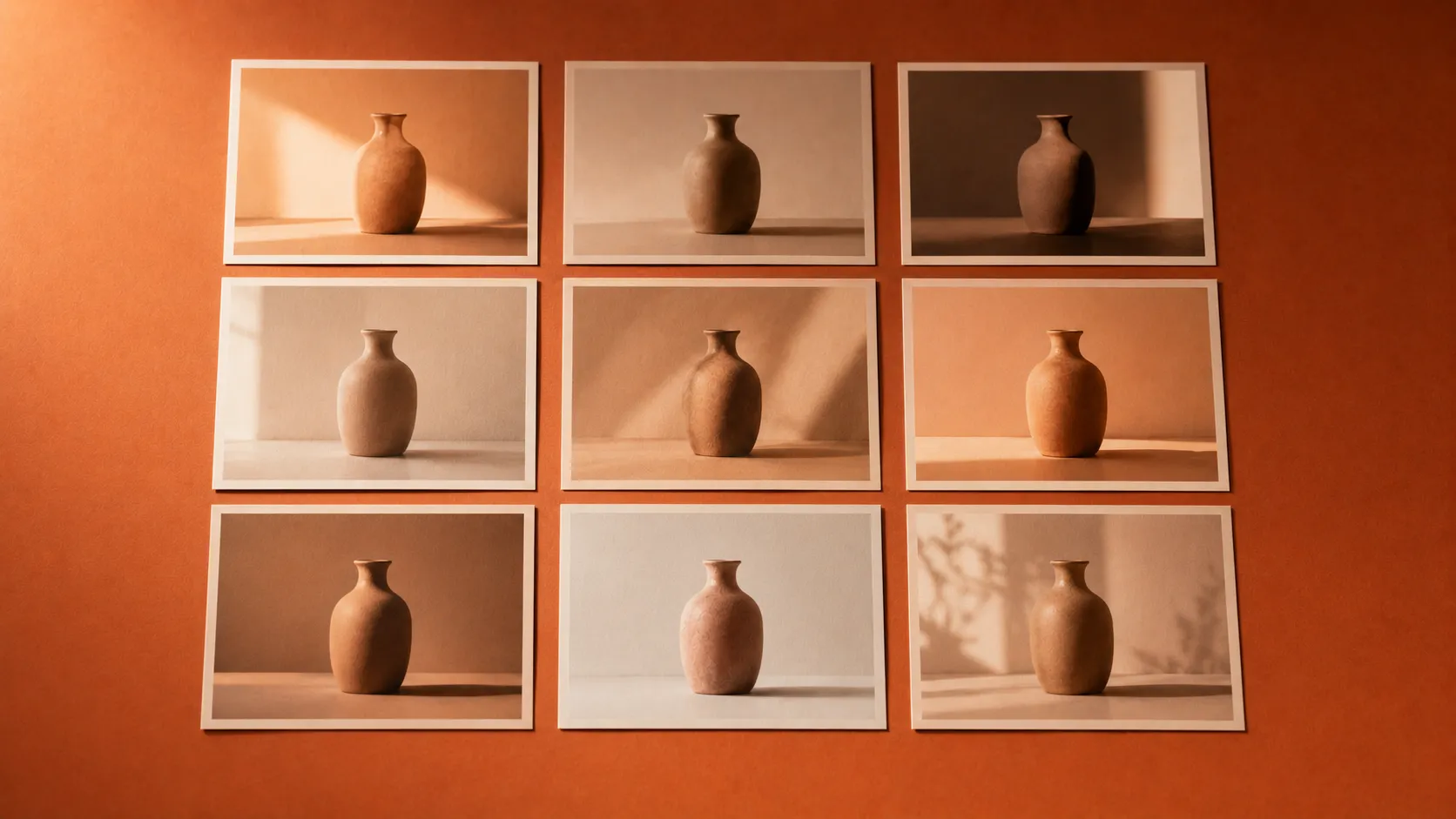
Producing one good AI image is easy; making a hundred look like the same brand is a different job. A prompt yields one output; consistency takes a system: visual references, lighting and color rules, framing standards, a prohibited list and an approval threshold. Without it, consistency breaks when the person changes, when time passes, or when the tool changes.
A marketing team produces fifty images in a week. Every one of them is technically good. But side by side, none of them looks like the others: one in warm tones, one cool, one almost an illustration.
The problem isn’t the tool. The tool already produces good images. The problem is that nothing ties the fifty together.
How does the difficulty grow?
This work has four levels, and the gap between them is bigger than people expect.
A single image. Easy. You describe what you want and it gets produced.
A campaign. It gets harder. Every piece has to feel connected to the others: the same visual language, different applications.
A catalog. Much harder. Hundreds of images, several people, sometimes several tools, one brand.
A brand system. The hardest. Whenever, wherever and with whatever tool an image is produced, it has to feel like it belongs to the same visual identity.
Most brands get good results at the first level, jump to the third and hit a wall there.
Why isn’t a prompt enough?
Consistency breaks at three points.
When the person changes. When two different people write the same prompt, the results differ. A prompt isn’t a recipe; it’s an interpretation. “Warm light” means sunset to one person and a studio lamp to another.
When time passes. Models get updated. In our experience, a prompt that gave a certain result three months ago can produce something different after an update. Your written prompt stays the same; your output changes.
When the tool changes. A prompt written for one tool doesn’t work in another. If a tool shuts down (and tools do), your prompt library becomes unusable too.
The common thread in all three: a prompt relies on words, and words are open to interpretation.
1 · Single image
Difficulty: easy.
What it takes: a good prompt.
2 · Campaign
Difficulty: moderate.
What it takes: a shared visual language.
3 · Catalog
Difficulty: high.
What it takes: rules and a reference set.
4 · Brand system
Difficulty: highest.
What it takes: a lasting, tool-independent system.
A prompt relies on words, and words are open to interpretation.
What does a system include?
A brand visual system is a layer that sits above the prompts. It has five parts.
Visual references. The most critical part: defining your brand’s visual language with examples rather than words. Instead of saying “this is our light,” you show an image that has that light. Modern tools can work from a reference image, and the guides published by image generation tools themselves say a consistent style comes from visual references, not from text descriptions alone.
Lighting and color rules. Written numerically: the color temperature in Kelvin, the RGB value of the background, how hard the shadows are. These leave no room for interpretation; a value either matches or it doesn’t.
Framing standards. How much of the frame the product fills, which angles it is shot from, how far from the camera it sits. Marketplace rules live in this layer too.
A prohibited list. Perhaps the most overlooked part. What is off-limits has to be written down as much as what is expected: which colors are never used, which scenes are never staged, which interventions are never made. This list protects the brand identity.
An approval threshold. What conditions must be met for an image to count as “good enough.” Without it, every delivery stays open to debate.
When these five come together, brand guidelines stop being a reference document and become the operating infrastructure of production.
How do you build a system?
Working backward from the archive you already have is faster and more accurate than writing from scratch.
Pick your best twenty images. The frames where you say, as a brand, “this is us.”
Extract their common traits. Where the light comes from, how hard the shadows are, which color family dominates, where the product sits in the frame, how plain the background is.
Make it numeric. Not “soft light” but measurable values. This is the step that closes the system to interpretation.
Add the prohibitions. Also pick ten images you don’t like, and write down why you don’t like them. These become your negative rules.
Lock the reference set. These images are now your library. Whoever is producing starts from here.
Can you build this yourself?
Let’s be clear: you don’t need an agency for the steps above. A brand with a content team can do this on its own, and should.
Our claim lies elsewhere: we built and ran this system at a volume of more than 50,000 images. Building a system is a one-day job; keeping it working at the hundredth product is something else. That is where the difference shows.
Frequently Asked Questions
Wouldn’t building a prompt library be enough?
It helps in part, but it isn’t enough on its own. Prompts rely on words, words are open to interpretation, and they depend on the tool. Without visual references, numeric rules and a prohibited list, a prompt library falls apart over time.
At what point do you need a system?
There is no fixed threshold, but in practice the need becomes clear once you go past about ten images a week and more than one person is producing. If one person makes a small number of images, a system can be unnecessary overhead.
We already have brand guidelines. Aren’t they enough?
Classic brand guidelines are written for color, logo and typography; they don’t cover image production decisions. Lighting, framing, scene setup and limits on intervention are usually missing from those documents. The two complement each other: the visual system is what turns a guideline from a reference document into production infrastructure.
Will the system fall apart if we change tools?
Not if it is built correctly. Visual references, numeric rules and the prohibited list are independent of the tool. The only tool-dependent part is prompt writing, and that is the easiest part to rewrite. Whoever produces, and with whatever tool, still starts from the same reference set.
Let’s build your brand’s visual system together.
Starting from your existing archive, we extract your reference set, your rules and your approval threshold. No matter who produces the images, they look like the same brand. Take a look at our image production service.
The principles behind our production decisions: Our Production Principles
On tool dependency: Sora Shutdown and the Risk of Depending on One AI Tool
Sources (3)
- Sameness — Create Consistent AI Brand Images (framework for the consistency levels; offers a brand visual system service) — sameness.co
- Glean — Why you need both brand guidelines and AI prompts for consistency (enterprise AI platform) — glean.com
- getimg.ai — How to Generate AI Images in Consistent Style (image generation tool) — getimg.ai